Subterranean termites
Termite control in Bartlesville
Termites in a Bartlesville house usually announce themselves as pencil-wide mud tubes on the foundation, a burst of winged insects indoors, or trim that gives under a thumb. Call to talk it over with an independent local pest control company. In Oklahoma, termite work is its own licensed category and comes with a written contract.
Signs that point to termites
- Mud tubes running up a foundation wall, a pier or the edge of a slab. The workers build them to travel between the soil and wood without drying out.
- Winged insects coming out of a wall, a window frame or a crack in the slab, often followed by wings left lying on sills and floors.
- Wood that sounds hollow, or lets a flathead screwdriver sink in where it should be firm. EPA suggests probing exposed wood in exactly this way.
- Paint that bubbles, and baseboards or door frames that crumble at the bottom.
Flying ants get mistaken for termites all the time. EPA gives a quick way to tell: a termite's four wings are about equal in length and its antennae are straight, while an ant's front wings are longer than its hind wings and its antennae bend at an elbow.
How they reach the wood
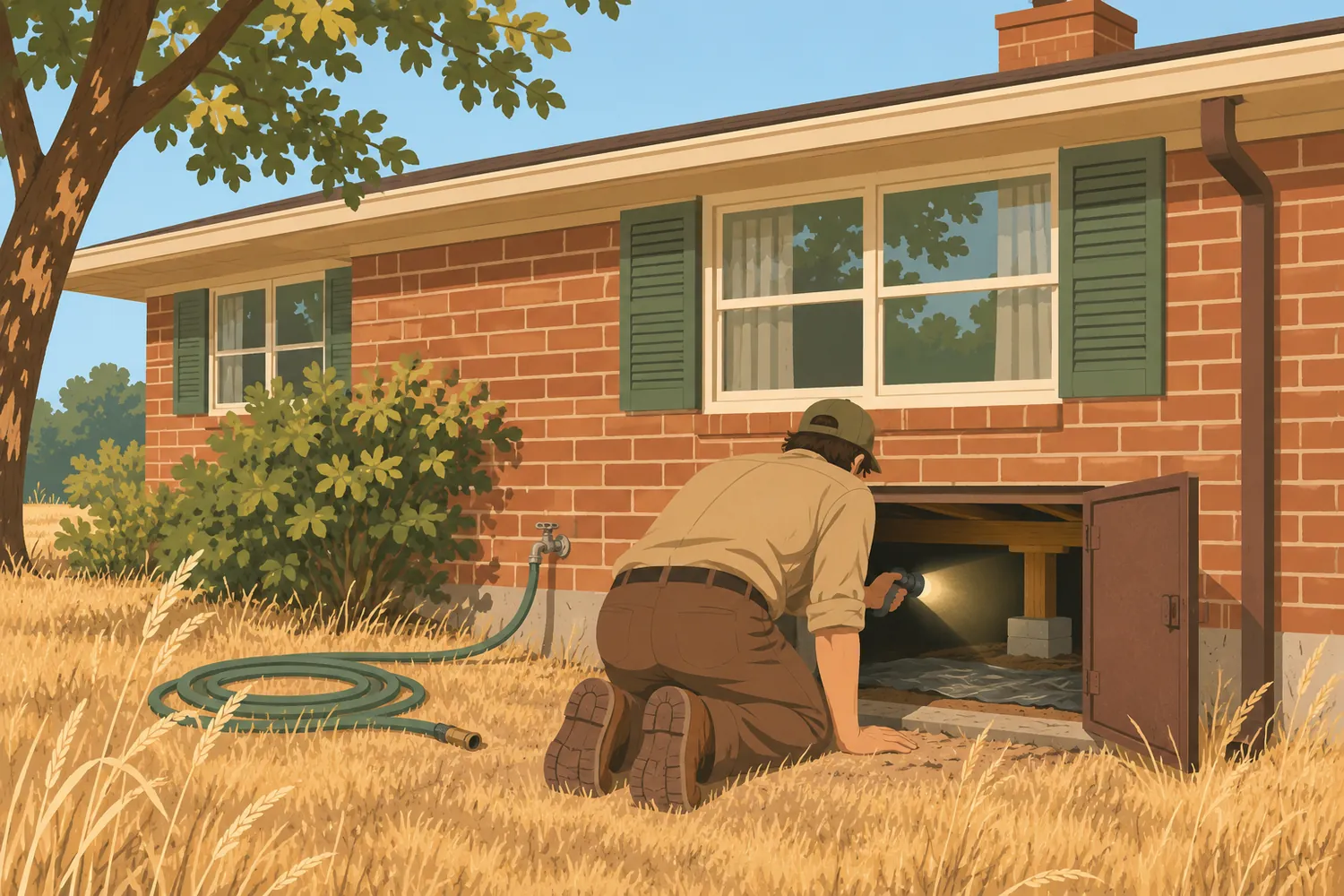
The native subterranean termite is the most common kind across most of the country, and it lives in the soil. It gets into a house through anything that bridges soil and wood or gives it a hidden path. Oklahoma's rules list the conditions an inspector has to write down, and the list works as a checklist for your own walk around the house:
- wood touching soil: siding, steps, fence posts, trim
- form boards left in the ground after construction
- damp soil from poor drainage, a dripping hose bib or a leaking line
- scrap wood and debris under or beside the house
- cracks and expansion joints in a slab
- a deck built tight against the house
- shrubs packed against the walls, or a woodpile leaning on them
What a treatment visit usually involves
The Oklahoma Department of Agriculture, Food and Forestry (ODAFF) sets minimum standards for termite work on existing houses. The company picks the method, but for a standard liquid soil treatment these are the steps you can expect to see:
- A trench along the outside of the foundation, with the soil treated and rod holes no more than 12 inches apart.
- Holes drilled through a slab, porch or patio wherever it blocks the soil, plugged again afterward.
- Brick veneer drilled at intervals of no more than 16 inches so the hollow behind it can be treated, along with slab expansion joints and the base of a fireplace or chimney.
- In a crawl space: scrap wood raked out, visible form boards pulled, soil dug back from low joists where needed, and an access opening of at least 14 by 16 inches if a new one has to be cut.
- Removal of every mud tube that can be reached.
Bait systems are the other common route. Stations go into the soil around the house and get checked on a schedule, and the termites carry a slow-acting bait back to the colony. ODAFF posts consumer fact sheets for the bait systems registered in Oklahoma on its pesticides page. Ask which approach the company suggests for your house, and why.
The contract is part of the job
Oklahoma requires a written contract for termite work, and it has to say more than a price. Read it at the table before you sign, and ask about anything that isn't clear.
If the house is being bought or sold, the inspection report is a separate document with its own rules. See termite reports for home sales.
What the contract should show
- A diagram or plat marking where live termites and damage were seen, and how the treatment was applied.
- Any minimum standard the company won't meet at your house, with the reason in writing.
- A plain statement if damaged wood won't be replaced or repaired.
- Every service term, cancellation included, explained before you sign, and a copy in your hand at signing.
Wells, cisterns and getting back inside
If the property has a private well or a cistern, say so on the first call. Oklahoma's rules don't allow a soil-applied termiticide at a structure containing a well or cistern unless the product label permits it, and EPA warns that a badly done barrier treatment can contaminate drinking water wells. The company may propose a different method.
Ask how long people and pets should stay out of treated rooms and get the answer in writing. EPA's advice is that the applicator should tell you when you can go back in, because the wait depends on the product label.
Getting the house ready
Preparation for termite work is mostly about access. The inspector needs to see the base of every outside wall, inside and out.
Before the visit
- Clear stored boxes and shelving away from the garage and utility room walls.
- Unlock the crawl space hatch and move anything stacked in front of it.
- Leave tubes, wings and damaged wood as they are. They show where the activity is.
- Write down where and when you saw swarmers.
- Find any earlier termite paperwork, including a report from when you bought the house.
After the treatment
EPA lists simple habits that make a house less inviting once it has been treated:
- keep the soil along the foundation dry, with gutters clear and downspouts carrying water away
- fix plumbing and roof leaks promptly
- keep foundation vents clear of plants
- trim shrubs back so they don't touch exposed wood
- store firewood away from the walls
- seal cracks where pipes and wires pass through the foundation
Keep the contract with the house papers. Termite work is the kind a future buyer's inspector will ask about.
Termite questions
Should I spray the swarm myself?
Spraying the swarm won't touch the colony in the soil, and it can wipe away the evidence the inspector needs. Keep a few in a sealed bag, vacuum up the rest, and call.
Is a termite inspection the same as the report for selling a house?
No. A real estate transaction uses Oklahoma's wood infestation report, on a state form. Here is what it covers.
Which license should the company hold?
Termite work is ODAFF category 7b, structural pest control. The guide to checking a company shows how to look it up.
Can I live in the house during treatment?
Usually, with some rooms off limits for a while. The product label sets the wait, so ask the company before the visit.
Something living in the house that shouldn't be?
Describe it on the phone to an independent pest control company that works around Bartlesville. Whether anyone comes out is your call.